 Live
Cognitive
·
vrgonogogame
Pause
Response Inhibition, Sustained Attention, Cognitive Flexibility
In the Pause Task, clients must distinguish between allowed and forbidden stimuli, respond to target stimuli, and withhold responses to forbidden stimuli. This exercise is part of the well-known ‘Go/No-Go’ test family.
Gameplay
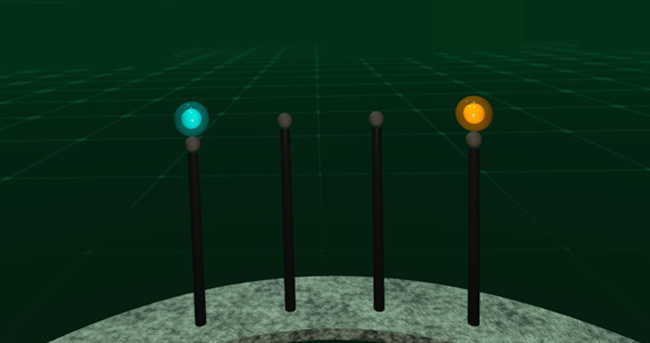
In the Pause Task (Go/No-Go), visual stimuli appear continuously and sequentially in various positions. The client must decide whether to respond or withhold their response based on features such as color, shape, or accompanying sound. In certain stages, the visual and auditory stimuli may conflict, or a ‘stop’ signal may appear mid-response, requiring the client to cease movement immediately. As the presentation speed increases and distractions or rule changes are introduced, the task progressively challenges response inhibition, impulse control, sustained attention, and cognitive flexibility under increasingly demanding conditions.
Therapeutic purpose
The primary goal of the Delaying Response exercise is to strengthen the ability to discriminate between stimuli, inhibit inappropriate responses, and maintain attention in the presence of continuous and distracting stimuli.
Who is this task suitable for?
- Individuals seeking to enhance their cognitive performance.
- Individuals with attention and response-control difficulties, including some individuals with attention-deficit/hyperactivity disorder (ADHD).
- Individuals experiencing difficulties with response inhibition and executive functioning following traumatic brain injury (TBI), stroke, or frontal lobe injury.
- Individuals who have difficulty inhibiting immediate reactions, controlling impulsive behaviors, or following rules.
- Older adults who may benefit from training in sustained attention, response speed, or cognitive control.
Centers and Professionals Who May Use the task
- Cognitive rehabilitation centers.
- Psychology and psychiatry clinics, particularly those providing services for ADHD and impulse-control difficulties.
- Rehabilitation centers serving individuals with brain injuries, stroke, or frontal lobe injuries.
- Occupational therapy centers.
- Geriatric care centers and cognitive assessment centers.
Cognitive Indices Associated with the task
Primary Indices:
- Response Inhibition: The ability to withhold responses to prohibited stimuli.
- Impulse Control: The ability to regulate immediate reactions and hasty responses; a broader concept than response inhibition.
- Sustained Attention: The ability to maintain attention throughout continuous task performance.
- Selective Attention: The ability to focus on relevant stimuli while ignoring distracting stimuli.
- Cognitive Flexibility: The ability to shift mental rules and adapt responses to a new rule.
Additional Indices Engaged Depending on the Active Exercise Features:
- Interference Control: The ability to manage conflicts between visual and auditory information and select a response according to the relevant rule.
- Reactive Inhibition: The ability to stop an ongoing response upon receiving a stop signal.
- Proactive Inhibition: The ability to anticipate and prepare to inhibit a potential response before receiving a stop signal.
- Vigilance: The ability to maintain readiness to respond as the intervals between stimuli gradually increase.
- Response Speed: The ability to identify a stimulus and respond within the specified time limit.
- Response Accuracy and Stimulus Discrimination: The ability to correctly distinguish between permitted and prohibited stimuli while minimizing response errors and failures to respond.
Clinician guide
Place the headset on the client’s head and prepare the exercise environment. Start the exercise from the first stage and closely follow the instructions.
Recorded metrics
- Two error faces kept apart: haste errors (catching a no-catch) and lapse errors (missing a catchable)
- The patient's “impulsive” vs “inattentive” profile at a glance
- Reaction speed and the ability to cancel a started movement
- Performance stability across the session
Science & evidence
Pause targets response inhibition and self-restraint: withholding a movement that is ready to fire — together with sustained attention and reaction speed.
Scientific basis
The exercise rests on two classic paradigms: Go/No-Go and the Stop-Signal Task, which quantifies the cancellation of an already-initiated movement via the SSRT (Logan & Cowan, 1984; Verbruggen & Logan, 2008). Response inhibition depends particularly on the right inferior frontal cortex (Aron et al., 2004). Monitoring rare targets over long periods derives from the Continuous Performance Test (Rosvold et al., 1956).
Use in the cognitive treatment pathway
Impulsivity in ADHD, hasty behaviour after stroke and brain injury, and addiction-recovery programs are targets. Separating "haste errors" (responding to a No-Go) from "lapse errors" (missing a Go) reveals the patient's impulsive-vs-inattentive profile at a glance and sets the direction of training.
VR & digital evidence
A meta-analysis of virtual-classroom continuous performance tests confirmed their power to delineate ADHD (Parsons & Duffield, 2019), and the AULA VR attention test has standardised normative data (Iriarte et al., 2016).
This exercise is a rehabilitation aid, not a substitute for clinical assessment or therapy; program selection and interpretation of results remain with the care team.
References
- Logan GD, Cowan WB. On the ability to inhibit thought and action: a theory of an act of control. Psychological Review. 1984;91(3):295–327. doi:10.1037/0033-295X.91.3.295
- Verbruggen F, Logan GD. Response inhibition in the stop-signal paradigm. Trends in Cognitive Sciences. 2008;12(11):418–424. doi:10.1016/j.tics.2008.07.005
- Aron AR, Robbins TW, Poldrack RA. Inhibition and the right inferior frontal cortex. Trends in Cognitive Sciences. 2004;8(4):170–177. doi:10.1016/j.tics.2004.02.010
- Rosvold HE, Mirsky AF, Sarason I, Bransome ED, Beck LH. A continuous performance test of brain damage. Journal of Consulting Psychology. 1956;20(5):343–350. doi:10.1037/h0043220
- Parsons TD, Duffield T. A comparison of virtual reality classroom continuous performance tests to traditional continuous performance tests in delineating ADHD: a meta-analysis. Neuropsychology Review. 2019;29(3):338–356. doi:10.1007/s11065-019-09407-6
Gallery

Request a demo
See SyneuraX up close
A live demo session for your care team — a real exercise on the headset, live monitoring on the server, and a walk through the reports. Free, with no commitment.