
 Live
Cognitive
·
vrmonumentgame
Monument
Planning, Problem Solving, Visuospatial Working Memory
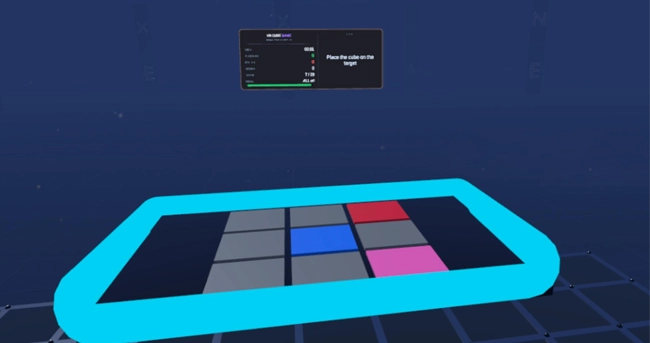
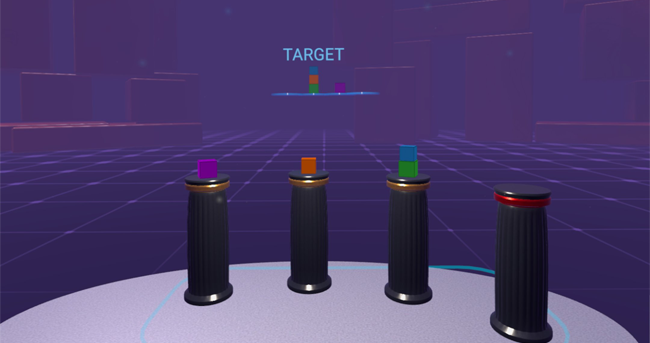
The Monument task is based on the logic of the Tower of London (TOL) test, in which the user must reconstruct a structure according to the target pattern or specified rules by moving and placing pieces on the platforms.
Introduction video
Gameplay
The Monument exercise is one of the most engaging and powerful exercises in SyneuraX, designed with inspiration from the Tower of London (TOL) test. In this exercise, the client faces the challenge of reconstructing a complex structure that tests their precision, patience, and spatial perception. In Monument, the client may encounter the following:
Time and movement challenges: to strengthen reaction speed and decision-making under pressure.
Perspective shifts: to improve spatial awareness and mental flexibility.
Variable patterns: to enhance working memory and analytical ability.
This exercise directly focuses on strengthening three core pillars of cognition: Precise Planning, Problem Solving, and Visuospatial Working Memory.
Therapeutic purpose
In this Task, the client must observe the pattern or predefined rules, plan the construction stages, select the appropriate sequence of movements, and retain the required information in mind throughout the task. As the stages progress, challenges such as increased structural complexity, limited number of moves, time constraints, visual distractions, changes in angle and pattern, mirror construction, fading of the pattern, re-observation, and reconstruction from shadow are added.
The primary targeted indices in Monument are:
- Planning
- Problem-solving
- Visuospatial working memory
In addition, the exercise can also engage sustained and selective attention, inhibitory control, cognitive flexibility, visuospatial processing and perception, visual memory, sequencing, action organization, error monitoring, decision-making, and processing speed.
Applications in children and adolescents:
Monument can be used as part of cognitive intervention and rehabilitation programs for children who show weaknesses in attention, working memory, planning, response control, and executive functions. In this regard, it may be applied in adjunctive therapy programs related to ADHD, attention problems, and certain learning disorders. For example, in children with mathematical learning disorder (dyscalculia), the exercise can engage underlying cognitive processes such as working memory, attention, planning, and problem-solving; however, the exercise itself is not considered direct training of mathematical skills.
Applications in adults and the elderly:
In adults, Monument can also be used as an adjunctive tool in cognitive rehabilitation programs for acquired brain injury, traumatic brain injury (TBI), stroke, and executive function disorders. It may also be employed in certain conditions such as Parkinson’s disease, as well as in active aging programs and the maintenance of cognitive functions, as one of the cognitive exercises.
Overall, Monument is more suitable for clients who need practice in executive functions, attention, working memory, and visuospatial processing, and its difficulty level can be adjusted according to the client’s abilities and performance.
Clinician guide
Place the VR headset on the patient’s head and configure the environment. Then, activate the ‘Start Exercise’ button and guide the patient according to the exercise instructions throughout the process.
Recorded metrics
- Planning quality (how many moves beyond necessary?)
- Deliberation time before the first move
- Reliance on “another look”
- Hasty errors and post-error recovery
Science & evidence
Monument trains planning and executive function in their most demanding form: seeing several moves ahead, inhibiting hasty action, and holding the goal in working memory under constraints.
Scientific basis
The exercise is built on the Tower of London task, which Shallice (1982) designed to detect the specific planning impairment that follows frontal-lobe damage: pieces must reach a target arrangement in the fewest legal moves. Later standardised versions turned it into a clinical measure of executive function (Culbertson & Zillmer, 1998).
Use in the cognitive treatment pathway
Weak planning and organisation after frontal injury, stroke and in ageing are rebuilt step by step. A built-in optimal solver compares the patient's move count with the shortest solution; "time-to-first-move" and move efficiency index planning quality. Hiding the hologram adds a working-memory load.
VR & digital evidence
A pilot randomised controlled trial of head-mounted-display VR cognitive training in neurorehabilitation showed a significant improvement in the Tower of London planning domain (Kober et al., 2023).
This exercise is a rehabilitation aid, not a substitute for clinical assessment or therapy; program selection and interpretation of results remain with the care team.
References
- Shallice T. Specific impairments of planning. Philosophical Transactions of the Royal Society B. 1982;298(1089):199–209. doi:10.1098/rstb.1982.0082
- Culbertson WC, Zillmer EA. The Tower of London(DX): a standardized approach to assessing executive functioning in children. Archives of Clinical Neuropsychology. 1998;13(3):285–301.
- Kober SE, et al. Cognitive training with head-mounted display virtual reality in neurorehabilitation: pilot randomized controlled trial. JMIR Serious Games. 2023;11:e45816. doi:10.2196/45816
Gallery

Request a demo
See SyneuraX up close
A live demo session for your care team — a real exercise on the headset, live monitoring on the server, and a walk through the reports. Free, with no commitment.