 Live
Live
Cognitive
·
vrdualtaskgame
Lookout
Two jobs at once — the art of divided attention
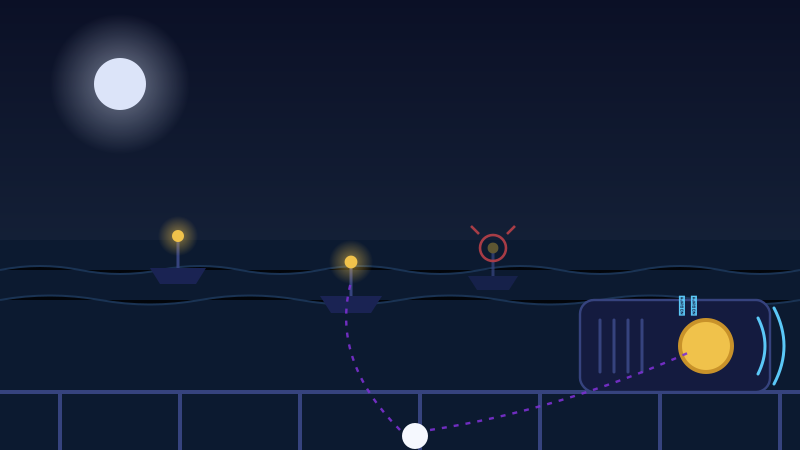
The patient keeps watch on a lighthouse deck: eyes on the boats' lanterns at sea, ears on the radio's special signal — a true dual-task workout.
Gameplay
On a moonlit night the patient holds two duties on the lighthouse deck: with the eyes, watch the boats' lanterns on the sea and “repair” any lantern fading out; with the ears, mind the console radio and press the big brass button whenever the double horn sounds.
The difficulty is the stuff of real life: neither job is hard on its own; the hard part is forgetting neither. Events sometimes collide on purpose to train rapid attention switching. Sessions start with single-task levels and then combine the two — which is precisely what makes the cost of doing both measurable.
Motor complement
Alternating far gaze (sea) and near gaze (console) is valuable oculomotor work; the touch button and the sea's width add reaching and trunk rotation.
Therapeutic purpose
Lookout targets divided attention — the ability used when “walking and talking at the same time”, whose decline is a known predictor of falls.
- Older adults at risk of falling
- MS, Parkinson's and post-stroke rehabilitation
- Adult ADHD
Clinician guide
The design is final and the exercise is queued for production. Once released, the visual/auditory event rates, the amount of deliberate overlap and the single-/dual-task level lengths are configured in the Level Designer.
- Follow the news section for the release announcement.
Recorded metrics
- The “dual-task cost” — performance drop when doing both vs. one
- Which channel (eye or ear) gets sacrificed
- Accuracy and response speed per channel, separately
Science & evidence
Lookout targets divided attention: doing two tasks at once without dropping either — the very ability used when "walking and talking at the same time".
Scientific basis
When two tasks run together, performance drops; this "dual-task cost" is the standard measure of cognitive-motor interference (Woollacott & Shumway-Cook, 2002; Al-Yahya et al., 2011). In older adults, "stops walking when talking" predicts falls (Lundin-Olsson et al., 1997). By starting with single-task levels and then combining them, Lookout measures that cost precisely.
Use in the cognitive treatment pathway
Older adults at risk of falling, and people with MS, Parkinson's and post-stroke deficits, benefit from this exercise. Measuring which channel (visual or auditory) gets sacrificed under interference, and by how much, tells the clinician which skill to load.
VR & digital evidence
An RCT of VR-based combined physical-cognitive training in older adults with MCI improved executive function and dual-task gait (Liao et al., 2019), and recent systematic reviews confirm reductions in dual-task completion time.
This exercise is a rehabilitation aid, not a substitute for clinical assessment or therapy; program selection and interpretation of results remain with the care team.
References
- Lundin-Olsson L, Nyberg L, Gustafson Y. "Stops walking when talking" as a predictor of falls in elderly people. The Lancet. 1997;349(9052):617. doi:10.1016/S0140-6736(97)24009-2
- Woollacott M, Shumway-Cook A. Attention and the control of posture and gait: a review of an emerging area of research. Gait & Posture. 2002;16(1):1–14. doi:10.1016/S0966-6362(01)00156-4
- Al-Yahya E, Dawes H, Smith L, Dennis A, Howells K, Cockburn J. Cognitive motor interference while walking: a systematic review and meta-analysis. Neuroscience & Biobehavioral Reviews. 2011;35(3):715–728. doi:10.1016/j.neubiorev.2010.08.008
- Liao YY, et al. Effects of virtual reality-based physical and cognitive training on executive function and dual-task gait performance in older adults with mild cognitive impairment: a randomized control trial. Frontiers in Aging Neuroscience. 2019;11:162. doi:10.3389/fnagi.2019.00162

Request a demo
See SyneuraX up close
A live demo session for your care team — a real exercise on the headset, live monitoring on the server, and a walk through the reports. Free, with no commitment.