
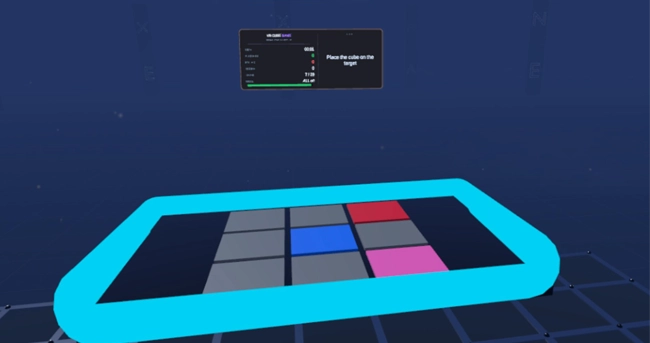
 Live
Live
Cognitive
·
vrerrandsgame
Errands
The market stall — the mind's real-life skills
The patient runs a market stall: gathering orders by hand, honoring the stall's rule, and remembering to turn the kettle off — the suite's most life-like exercise.
Gameplay
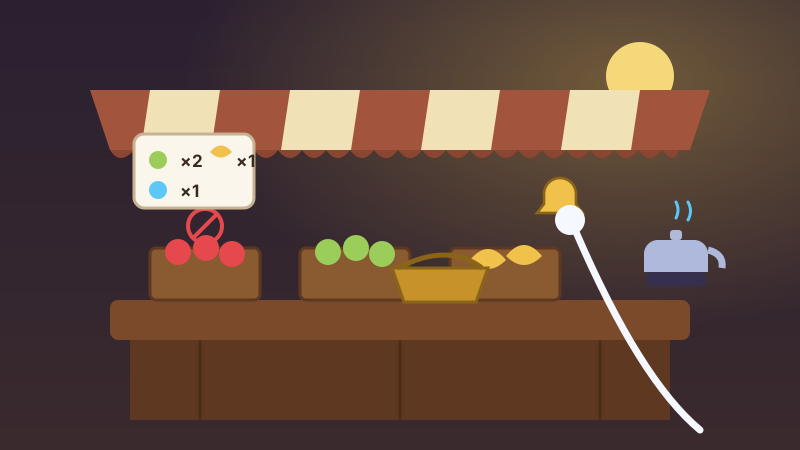
A golden morning, a wooden market stall. The patient is the seller: a fully pictorial order card shows what the customer wants — say two apples, one bread, a blue jug. The goods must be picked from the crates by hand, placed in the basket, and the bell rung. But running a stall is more than filling orders…
Layers of real life arrive one by one: the order card flips away after a few seconds (continue from memory); the stall's rule says red goods are never sold — even if the customer asks; the kettle on the stove whistles now and then and must be remembered mid-task (“prospective memory” — the same faculty that gets pills and appointments remembered on time); and sometimes a small urgent order lands mid-work, after which the half-done task must be resumed exactly where it stopped. Each level adds just one new layer, keeping progress stepwise and encouraging.
Motor complement
Alongside Monument, the suite's most physical exercise: repeated grasping and carrying of goods across the stall, with crates placeable low for controlled bending.
Therapeutic purpose
Errands targets everyday executive function: following a multi-step order, honoring a rule, prospective memory (“remember to…”) and getting back on a half-finished task after interruption.
- Regaining independence in shopping and the kitchen after stroke and TBI
- MS and mild cognitive impairment
- Vocational rehabilitation and forgotten unfinished tasks
Clinician guide
The design is final and the exercise is queued for production. Once released, order length, card visibility time, the stall rule and kettle, and urgent interruptions are configured in the Level Designer.
- Follow the news section for the release announcement.
Recorded metrics
- Orders completed correctly on the first attempt
- Timely kettle/hourglass responses (prospective memory)
- Rule adherence even under pressure
- Time to get back on task after each interruption
Science & evidence
Errands targets everyday executive function: following a multi-step order, honouring a rule, prospective memory, and getting back on a half-finished task after interruption — the suite's most life-like exercise.
Scientific basis
The exercise is inspired by the Multiple Errands Test, which Shallice & Burgess (1991) created to expose an executive deficit that stays hidden in desk-bound tests. Prospective memory — remembering to do something in the future, such as turning off the kettle — is a separate, vital domain (Einstein & McDaniel, 1990), and the Virtual Week task is a model way to measure it (Rendell & Craik, 2000).
Use in the cognitive treatment pathway
Regaining independence in shopping and the kitchen after stroke and TBI, MS, and vocational rehabilitation are targets. Orders correct on the first attempt, timely kettle responses (prospective memory), rule adherence under pressure and the "get-back-on-task" time after interruption quantify everyday function.
VR & digital evidence
Training with the Virtual Week computer game in older adults improved prospective memory with accompanying neural plasticity (Rose, Rendell et al., 2015).
This exercise is a rehabilitation aid, not a substitute for clinical assessment or therapy; program selection and interpretation of results remain with the care team.
References
- Shallice T, Burgess PW. Deficits in strategy application following frontal lobe damage in man. Brain. 1991;114(2):727–741. doi:10.1093/brain/114.2.727
- Einstein GO, McDaniel MA. Normal aging and prospective memory. Journal of Experimental Psychology: Learning, Memory, and Cognition. 1990;16(4):717–726. doi:10.1037/0278-7393.16.4.717
- Rendell PG, Craik FIM. Virtual Week and actual week: age-related differences in prospective memory. Applied Cognitive Psychology. 2000;14(7):S43–S62. doi:10.1002/acp.770
- Rose NS, Rendell PG, et al. Cognitive and neural plasticity in older adults' prospective memory following training with the Virtual Week computer game. Frontiers in Human Neuroscience. 2015;9:592. doi:10.3389/fnhum.2015.00592


Request a demo
See SyneuraX up close
A live demo session for your care team — a real exercise on the headset, live monitoring on the server, and a walk through the reports. Free, with no commitment.