
 Live
Live
Cognitive
·
vrgonogogame
Pause
Catch… but sometimes hold back — impulse control
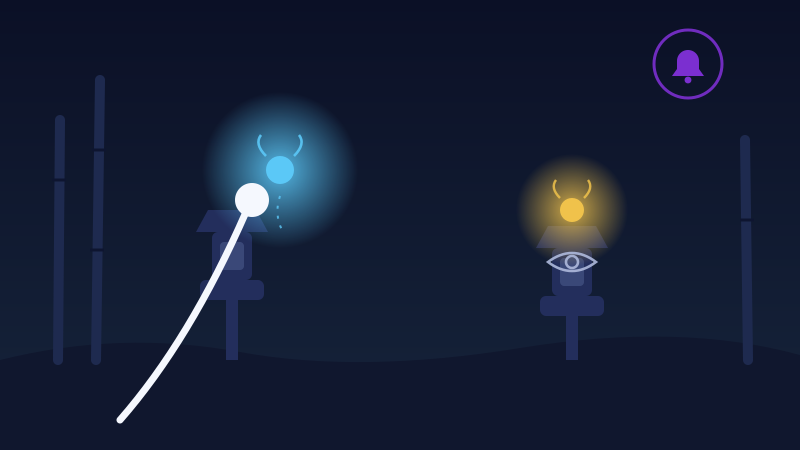
In a twilight Japanese garden, blue fireflies must be caught fast and amber ones only watched — training self-restraint, the mind's brake and sustained attention.
Gameplay
Glowing fireflies light up one by one on the garden's stone lanterns. The rule is simple: catch the blue, let the amber go. But as the pace rises, the eager hand moves faster than the thought — and that is exactly where the exercise does its work.
Telling the “no-catch” targets apart gets harder level by level: first by color, then by shape details, then by sound alone, and finally even with deliberate sound–image conflict. In special levels a “stop bell” rings right after a catchable firefly appears — a movement already started must be cancelled; one of the best-known workouts for the mind's brake. Distinctive touch: successful restraint is rewarded too, not just timely catches.
Motor complement
In touch mode the fireflies are physically “caught” with the palm; the exercise can be restricted to the left hand, the right, or alternating — fit for one-sided rehabilitation.
Therapeutic purpose
Pause targets impulse control and self-restraint — holding back a response that is ready to fire — together with sustained attention and reaction speed.
- Adult and adolescent ADHD and impulsivity
- Impulsive behavior after stroke and brain injury
- Addiction-recovery programs and older adults
Clinician guide
The design is final and the exercise is queued for production. Once released, the catch/no-catch ratio, appearance pace, distinction type (color/shape/sound) and the stop bell are configured in the Level Designer.
- Follow the news section for the release announcement.
Recorded metrics
- Two error faces kept apart: haste errors (catching a no-catch) and lapse errors (missing a catchable)
- The patient's “impulsive” vs “inattentive” profile at a glance
- Reaction speed and the ability to cancel a started movement
- Performance stability across the session
Science & evidence
Pause targets response inhibition and self-restraint: withholding a movement that is ready to fire — together with sustained attention and reaction speed.
Scientific basis
The exercise rests on two classic paradigms: Go/No-Go and the Stop-Signal Task, which quantifies the cancellation of an already-initiated movement via the SSRT (Logan & Cowan, 1984; Verbruggen & Logan, 2008). Response inhibition depends particularly on the right inferior frontal cortex (Aron et al., 2004). Monitoring rare targets over long periods derives from the Continuous Performance Test (Rosvold et al., 1956).
Use in the cognitive treatment pathway
Impulsivity in ADHD, hasty behaviour after stroke and brain injury, and addiction-recovery programs are targets. Separating "haste errors" (responding to a No-Go) from "lapse errors" (missing a Go) reveals the patient's impulsive-vs-inattentive profile at a glance and sets the direction of training.
VR & digital evidence
A meta-analysis of virtual-classroom continuous performance tests confirmed their power to delineate ADHD (Parsons & Duffield, 2019), and the AULA VR attention test has standardised normative data (Iriarte et al., 2016).
This exercise is a rehabilitation aid, not a substitute for clinical assessment or therapy; program selection and interpretation of results remain with the care team.
References
- Logan GD, Cowan WB. On the ability to inhibit thought and action: a theory of an act of control. Psychological Review. 1984;91(3):295–327. doi:10.1037/0033-295X.91.3.295
- Verbruggen F, Logan GD. Response inhibition in the stop-signal paradigm. Trends in Cognitive Sciences. 2008;12(11):418–424. doi:10.1016/j.tics.2008.07.005
- Aron AR, Robbins TW, Poldrack RA. Inhibition and the right inferior frontal cortex. Trends in Cognitive Sciences. 2004;8(4):170–177. doi:10.1016/j.tics.2004.02.010
- Rosvold HE, Mirsky AF, Sarason I, Bransome ED, Beck LH. A continuous performance test of brain damage. Journal of Consulting Psychology. 1956;20(5):343–350. doi:10.1037/h0043220
- Parsons TD, Duffield T. A comparison of virtual reality classroom continuous performance tests to traditional continuous performance tests in delineating ADHD: a meta-analysis. Neuropsychology Review. 2019;29(3):338–356. doi:10.1007/s11065-019-09407-6

Request a demo
See SyneuraX up close
A live demo session for your care team — a real exercise on the headset, live monitoring on the server, and a walk through the reports. Free, with no commitment.