 Live
Live
Cognitive
·
vrlandmarkgame
Landmark
What was where? — memory for places
Small objects take their places on a miniature island; then fog covers everything and the questions begin — targeted therapy for “where did I put it?”.
Gameplay
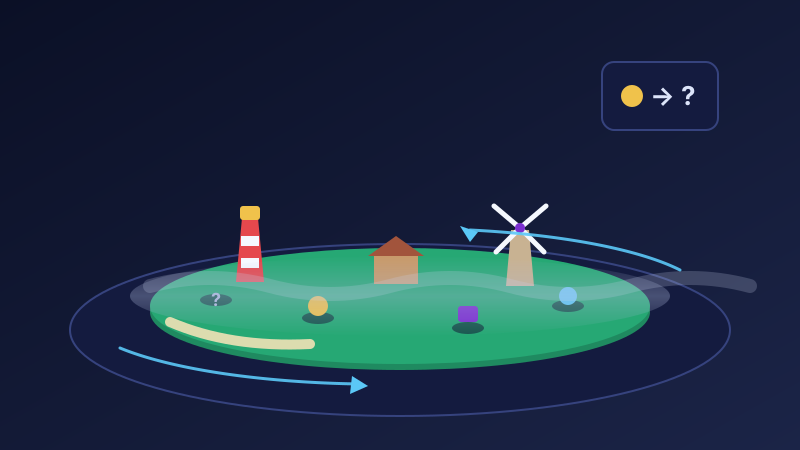
On the table sits a charming miniature island with a lighthouse, a cottage, a windmill and a pier. Small objects (a chest, a shell, a lantern, a boat…) appear on the island's marked spots; then fog rolls over it. Now come the questions: “Where was the shell?”, “What was beside the windmill?”, “What has moved?”
This is precisely the memory that draws the most everyday complaints: “Where did I put my keys?”. Landmark trains it deliberately — with visual anchors (landmarks) that build remembering strategies. At advanced levels the delay between memorizing and recall grows, very similar decoy objects appear, and most engaging of all: the island rotates between viewing and answering — object positions must be remembered independently of one's own viewpoint; the very skill real-world navigation depends on.
Motor complement
In touch mode, answering means physically touching points on the table — reaching across a horizontal surface with controlled forward lean.
Therapeutic purpose
Landmark targets spatial memory and object–place binding — the domain most sensitive to early memory change — along with change detection and seeing from another viewpoint.
- Mild cognitive impairment and early-stage Alzheimer's
- Age-related spatial forgetfulness and post-stroke memory deficits
- Memory complaints in depression
Clinician guide
The design is final and the exercise is queued for production. Once released, object count, recall delay, decoy similarity and island rotation are configured in the Level Designer.
- Follow the news section for the release announcement.
Recorded metrics
- Fine error separation: knew the object but not its place? fooled by a look-alike?
- The drop caused by island rotation (viewpoint-independent memory)
- How long a delay between viewing and recall is tolerated
Science & evidence
Landmark targets spatial memory and object–place binding — the domain most sensitive to early memory change — together with viewpoint-independent (allocentric) representation.
Scientific basis
The hippocampus builds a "cognitive map" of space (O'Keefe & Nadel, 1978). Short-term topographical memory depends on an intact hippocampus; the Four Mountains Test (Hartley et al., 2007) measures exactly this by shifting the viewpoint. By rotating the island between viewing and answering, Landmark forces the patient to remember object locations independently of their own position.
Use in the cognitive treatment pathway
Mild cognitive impairment and early-stage Alzheimer's, age-related spatial forgetfulness and post-stroke memory deficits are targets. Separating errors (knew the object but not its place? fooled by a look-alike?) and the drop caused by island rotation build a precise profile of the memory deficit.
VR & digital evidence
A VR navigation test differentiated mild cognitive impairment on an entorhinal-cortex basis (Howett et al., 2019), and the Four Mountains Test shows high sensitivity for pre-clinical Alzheimer's (Chan et al., 2016).
This exercise is a rehabilitation aid, not a substitute for clinical assessment or therapy; program selection and interpretation of results remain with the care team.
References
- O'Keefe J, Nadel L. The Hippocampus as a Cognitive Map. Oxford University Press; 1978.
- Hartley T, Bird CM, Chan D, et al. The hippocampus is required for short-term topographical memory in humans. Hippocampus. 2007;17(1):34–48. doi:10.1002/hipo.20240
- Howett D, et al. Differentiation of mild cognitive impairment using an entorhinal cortex-based test of virtual reality navigation. Brain. 2019;142(6):1751–1766. doi:10.1093/brain/awz116
- Chan D, et al. The 4 Mountains Test: a short test of spatial memory with high sensitivity for the diagnosis of pre-dementia Alzheimer's disease. Journal of Visualized Experiments. 2016;(116):e54454. doi:10.3791/54454
Request a demo
See SyneuraX up close
A live demo session for your care team — a real exercise on the headset, live monitoring on the server, and a walk through the reports. Free, with no commitment.