
 Live
Live
Cognitive
·
vrmonumentgame
Monument
See the structure, plan it, build it with your own hands
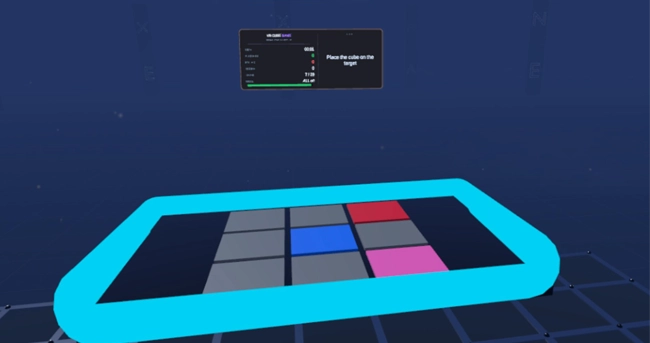
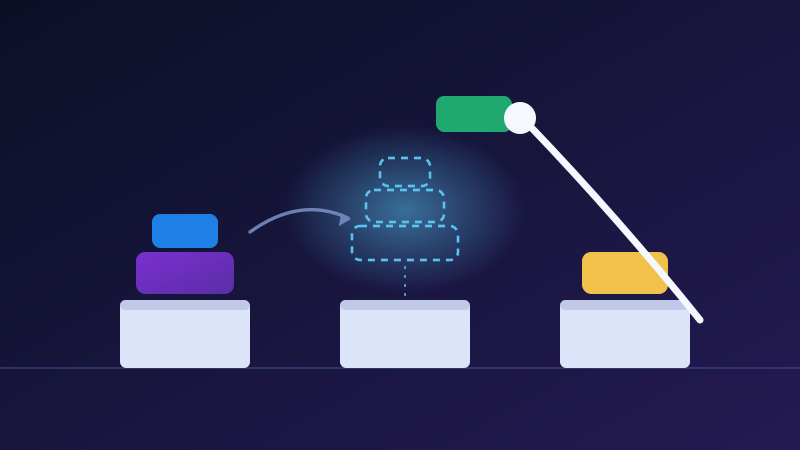
In a calm modern museum, a translucent image of the target structure glows above the middle pedestal; the patient must arrange the pieces — by real grasping and carrying — until the build matches the image exactly.
Gameplay
The game's rule forces the mind to plan: only the top piece of each pedestal can be lifted, so several steps must be seen before the first move.
At higher levels the target image fades after a few seconds (building from memory), moves become limited, and “another look” is allowed only a few times. Every piece that lands correctly earns a glow of confirmation.
Motor complement
The suite's strongest motor exercise alongside Errands: grasping, carrying and placing real pieces — shoulder and elbow range, hand-eye coordination and weight shifting.
Therapeutic purpose
Monument is the suite's heaviest executive-function exercise: planning before acting, restraining hasty moves and holding the goal in working memory — plus simultaneous work of mind and upper limb.
- Weak planning and task organization
- Frontal-lobe injuries
- Combined mind + upper-limb rehabilitation, active aging
Clinician guide
Once released, the piece count (3–8), hologram visibility window, move cap and time limit of each level are set in the Level Designer; a built-in optimal solver compares the patient's planning efficiency against the shortest solution.
- The design is final and the exercise is queued for production.
- Follow the news section for the release announcement.
Recorded metrics
- Planning quality (how many moves beyond necessary?)
- Deliberation time before the first move
- Reliance on “another look”
- Hasty errors and post-error recovery
Science & evidence
Monument trains planning and executive function in their most demanding form: seeing several moves ahead, inhibiting hasty action, and holding the goal in working memory under constraints.
Scientific basis
The exercise is built on the Tower of London task, which Shallice (1982) designed to detect the specific planning impairment that follows frontal-lobe damage: pieces must reach a target arrangement in the fewest legal moves. Later standardised versions turned it into a clinical measure of executive function (Culbertson & Zillmer, 1998).
Use in the cognitive treatment pathway
Weak planning and organisation after frontal injury, stroke and in ageing are rebuilt step by step. A built-in optimal solver compares the patient's move count with the shortest solution; "time-to-first-move" and move efficiency index planning quality. Hiding the hologram adds a working-memory load.
VR & digital evidence
A pilot randomised controlled trial of head-mounted-display VR cognitive training in neurorehabilitation showed a significant improvement in the Tower of London planning domain (Kober et al., 2023).
This exercise is a rehabilitation aid, not a substitute for clinical assessment or therapy; program selection and interpretation of results remain with the care team.
References
- Shallice T. Specific impairments of planning. Philosophical Transactions of the Royal Society B. 1982;298(1089):199–209. doi:10.1098/rstb.1982.0082
- Culbertson WC, Zillmer EA. The Tower of London(DX): a standardized approach to assessing executive functioning in children. Archives of Clinical Neuropsychology. 1998;13(3):285–301.
- Kober SE, et al. Cognitive training with head-mounted display virtual reality in neurorehabilitation: pilot randomized controlled trial. JMIR Serious Games. 2023;11:e45816. doi:10.2196/45816

Request a demo
See SyneuraX up close
A live demo session for your care team — a real exercise on the headset, live monitoring on the server, and a walk through the reports. Free, with no commitment.