
 Live
Live
Cognitive
·
vrneurocountgame
NeuroCount
The floating lab of precision — look, count, compare
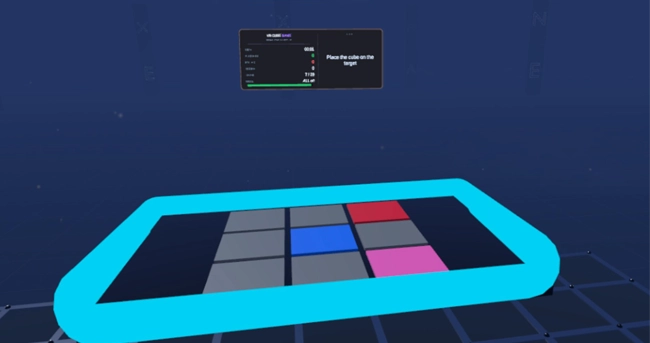
The patient stands in a lab suspended in light; every round brings a short mission: “How many shapes lie on this path?”, “How many cylinders match the reference height?”, “How many objects are left of the cat?”
Gameplay
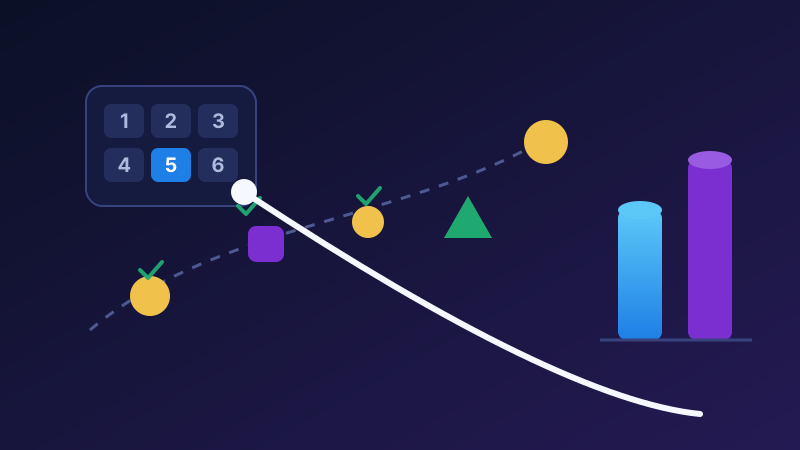
Ten different mission types, from simple counting to compound comparisons (“the large ones that are also yellow”) and scenes that drift gently while the patient answers. The variety keeps the mind from settling into one repeated pattern; every round, careful looking must be organized anew.
Answers go in through a simple number pad, and at the end of each round the correct count is shown as a teaching moment.
Motor complement
Left/right and above/below missions naturally force neck rotation and vertical gaze; the field width is adjustable.
Therapeutic purpose
NeuroCount trains visuospatial precision, counting and comparison, and selective attention in busy scenes — the foundations of navigation, money handling and the sense of time.
- Weak attention and visual carelessness
- Spatial-perception problems and post-stroke rehabilitation
- Mild cognitive impairment and precision training in older adults
Clinician guide
This exercise is fully built and now in final preparation for release. Mission type (1–10), object count, distraction and time limits are configured in the Level Designer.
- Follow the news section for the release announcement.
Recorded metrics
- Accuracy and speed per mission type, separately
- Shows exactly which processing type (counting, comparison, orientation…) is strong or weak
- Error patterns and how much of the visual field is used
Science & evidence
NeuroCount trains visuospatial processing, counting and number sense, and selective attention in busy scenes — the abilities behind navigation, handling money and grasping quantity.
Scientific basis
The mind has two enumeration mechanisms: subitizing, the instant apprehension of 1–4 items, and step-by-step counting for larger sets (Mandler & Shebo, 1982). These rest on an innate "number sense" (Dehaene, 1997). NeuroCount's wide-field tasks also recruit spatial attention and visual search — the very system impaired in hemispatial neglect.
Use in the cognitive treatment pathway
Acalculia and enumeration deficits after brain injury, and visuospatial neglect after stroke, are direct targets. Work starts with simple counts near the centre and progresses, as the field widens, toward head turning and active scanning; the error pattern (one-sided under-counting, comparison errors) gives the clinician a clue to the type of deficit.
VR & digital evidence
Systematic reviews of VR for assessing and rehabilitating neglect judge it a promising, sensitive tool (Pedroli et al., 2015; Martino Cinnera et al., 2022), though samples are small and larger trials are needed.
This exercise is a rehabilitation aid, not a substitute for clinical assessment or therapy; program selection and interpretation of results remain with the care team.
References
- Mandler G, Shebo BJ. Subitizing: an analysis of its component processes. Journal of Experimental Psychology: General. 1982;111(1):1–22. doi:10.1037/0096-3445.111.1.1
- Dehaene S. The Number Sense: How the Mind Creates Mathematics. Oxford University Press; 1997.
- Pedroli E, Serino S, Cipresso P, Pallavicini F, Riva G. Assessment and rehabilitation of neglect using virtual reality: a systematic review. Frontiers in Behavioral Neuroscience. 2015;9:226. doi:10.3389/fnbeh.2015.00226
- Martino Cinnera A, et al. Exploring the potential of immersive virtual reality in the treatment of unilateral spatial neglect due to stroke: a comprehensive systematic review. Brain Sciences. 2022;12(11):1589. doi:10.3390/brainsci12111589

Request a demo
See SyneuraX up close
A live demo session for your care team — a real exercise on the headset, live monitoring on the server, and a walk through the reports. Free, with no commitment.