
 Live
Live
Cognitive
·
vrpendulumgame
Pendulum
Move with the beat of time — sustained focus and rhythm
In a clockmaker's warm workshop the patient keeps time on a brass drum: syncing with the beat, answering at the swing's peak, staying vigilant for the clock that strikes 'wrong'.
Gameplay
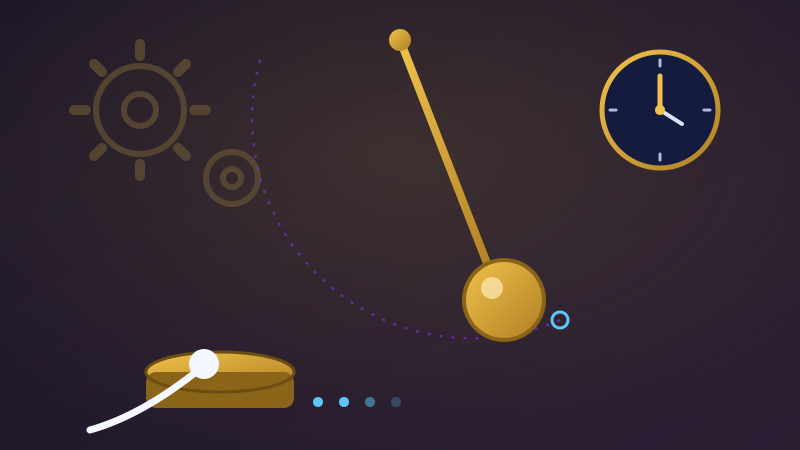
In the clockmaker's wooden workshop, great brass pendulums swing slowly and gears turn in silence. Standing at the workbench, the patient keeps time with a brass drum: sometimes striking on every beat, sometimes answering exactly at the pendulum's peak, sometimes rebuilding a heard time interval from memory — and sometimes, in the calmest and hardest mission, just staying vigilant for the moment one of the clocks strikes “wrong”.
A sense of time and the power to “stay in the moment” underpin many skills. This exercise builds both: rhythm synchronization (with a recognized place in Parkinson's rehabilitation), temporal anticipation instead of late reaction, and attention endurance through monotony. Feedback is deliberately subtle so the patient's rhythm never breaks; a small continuous indicator shows “too early or too late”.
Motor complement
Rhythmic striking is upper-limb motor work in itself; the two-drum mode (left–right alternating) trains bimanual coordination and movement symmetry.
Therapeutic purpose
Pendulum targets sustained attention and vigilance — the capacity that wears out in driving and long tasks — together with rhythm and movement timing.
- Parkinson's — rhythmic movement training
- Adult attention disorders and attention fatigue after brain injury
- Unstable movement timing and older adults
Clinician guide
The design is final and the exercise is queued for production. Once released, the tempo, mission type (sync/peak/interval rebuild/vigilance) and each segment's length are configured in the Level Designer.
- Follow the news section for the release announcement.
Recorded metrics
- Timing stability (how even are the strikes?)
- Bias toward striking early or late
- Attention lapses and focus decline from start to finish
Science & evidence
Pendulum targets sustained attention and vigilance — the capacity that wears out in driving and long tasks — together with rhythm and movement timing.
Scientific basis
The "vigilance decrement" on long, monotonous tasks has been known since Mackworth's Clock Test (1948); the SART measures everyday attentional lapses by requiring response withholding on a rare target (Robertson et al., 1997). Sensorimotor synchronisation to a beat is a studied field in itself, and in Parkinson's, Rhythmic Auditory Stimulation has a recognised therapeutic role (Thaut et al., 1996).
Use in the cognitive treatment pathway
Parkinson's (rhythmic movement training), attention fatigue after brain injury and unstable timing in ageing are targets. Timing stability, an early/late bias and the decline of attention from start to finish are the key markers.
VR & digital evidence
Meta-analyses of Rhythmic Auditory Stimulation trials in Parkinson's show improved gait and motor scores (review by Nombela et al., 2013; meta-analysis by Zhang et al., 2022).
This exercise is a rehabilitation aid, not a substitute for clinical assessment or therapy; program selection and interpretation of results remain with the care team.
References
- Mackworth NH. The breakdown of vigilance during prolonged visual search. Quarterly Journal of Experimental Psychology. 1948;1(1):6–21. doi:10.1080/17470214808416738
- Robertson IH, Manly T, Andrade J, Baddeley BT, Yiend J. 'Oops!': performance correlates of everyday attentional failures in traumatic brain injured and normal subjects. Neuropsychologia. 1997;35(6):747–758. doi:10.1016/S0028-3932(97)00015-8
- Thaut MH, McIntosh GC, Rice RR, Miller RA, Rathbun J, Brault JM. Rhythmic auditory stimulation in gait training for Parkinson's disease patients. Movement Disorders. 1996;11(2):193–200. doi:10.1002/mds.870110213
- Nombela C, Hughes LE, Owen AM, Grahn JA. Into the groove: can rhythm influence Parkinson's disease? Neuroscience & Biobehavioral Reviews. 2013;37(10):2564–2570. doi:10.1016/j.neubiorev.2013.08.003

Request a demo
See SyneuraX up close
A live demo session for your care team — a real exercise on the headset, live monitoring on the server, and a walk through the reports. Free, with no commitment.