 Live
Live
Cognitive
·
vrsequencegame
Echo
Memorize, then play it back in order — visual-auditory memory
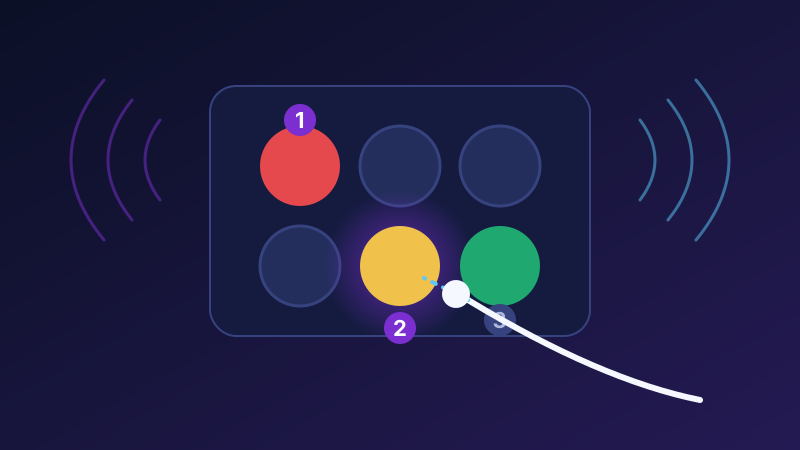
In a calm room, floating colored buttons light up and chime one by one; the patient repeats the order from memory — at higher levels, animal shapes with their real calls replace the colors.
Gameplay
Each round: watch and listen → a short pause → answer by pointing. Sequences grow longer step by step; then new challenges arrive: reverse recall (last to first — a strong working-memory workout), moving options and adjustable distractions.
The constant “shape + sound” pairing strengthens both memory channels — visual and auditory — together.
Motor complement
In touch mode the options come close and every choice requires a real reach — shoulder and balance work carrying the same mental load.
Therapeutic purpose
Echo targets visual and auditory memory, sequencing and working memory — the abilities measured by classic tests like digit span and Corsi blocks.
- Everyday forgetfulness and weak memory
- Mild cognitive impairment
- Rehabilitation after stroke and TBI
- Active aging
Clinician guide
Pick a level set; the first levels are short warm-ups. Configure “backward” mode and the distraction level (0–3) in the Level Designer, and follow the memory-span trend in the reports.
- Sequence length, recall mode and distraction shape each level's difficulty.
- Recommended level duration is 90–150 seconds.
- This exercise is currently in clinical evaluation.
Recorded metrics
- Memory span (longest successful sequence)
- Selection accuracy
- Response onset speed
- Performance difference in reverse mode and under distraction
Science & evidence
Echo rebuilds visual and auditory working memory and serial-order recall: holding and manipulating information across a short delay — the capacity that underpins mental arithmetic, following a conversation and carrying out multi-step instructions.
Scientific basis
Working memory is the limited-capacity system that briefly holds and manipulates information (Baddeley & Hitch, 1974). Forward and backward span tasks and the Corsi Block-Tapping Test are the classic clinical measures of verbal and visuospatial span (Corsi, 1972; Kessels et al., 2000). Echo's watch/listen-then-reproduce structure — especially its reverse mode — maps directly onto these paradigms.
Use in the cognitive treatment pathway
Working-memory deficits are common after stroke and traumatic brain injury, in mild cognitive impairment, ADHD and healthy ageing. Begin with short forward sequences to establish span, then grow the length and add reverse recall and graded distraction; the recorded span and accuracy trend tell the clinician where to start the next session.
VR & digital evidence
Systematic reviews and RCTs of VR/computerised cognitive training in older adults and MCI report gains in immediate and delayed memory and in attention (Brunner et al., 2025; Liu et al., 2025), although far transfer remains debated and clinician oversight matters.
This exercise is a rehabilitation aid, not a substitute for clinical assessment or therapy; program selection and interpretation of results remain with the care team.
References
- Baddeley AD, Hitch G. Working memory. Psychology of Learning and Motivation. 1974;8:47–89. doi:10.1016/S0079-7421(08)60452-1
- Corsi PM. Human memory and the medial temporal region of the brain [doctoral dissertation]. McGill University; 1972.
- Kessels RPC, van Zandvoort MJE, Postma A, Kappelle LJ, de Haan EHF. The Corsi Block-Tapping Task: standardization and normative data. Applied Neuropsychology. 2000;7(4):252–258. doi:10.1207/S15324826AN0704_8
- Brunner I, et al. Virtual reality interventions for older adults with mild cognitive impairment: systematic review and meta-analysis of RCTs. Journal of Medical Internet Research. 2025. doi:10.2196/59195

Request a demo
See SyneuraX up close
A live demo session for your care team — a real exercise on the headset, live monitoring on the server, and a walk through the reports. Free, with no commitment.