
 Live
Live
Cognitive
·
vrtrailgame
Trails
Stitch the stars in order — speed of mind
Under the observatory's starry dome, numbered stars must be found and linked in order with a beam of light — training processing speed, visual search and mental agility.
Gameplay
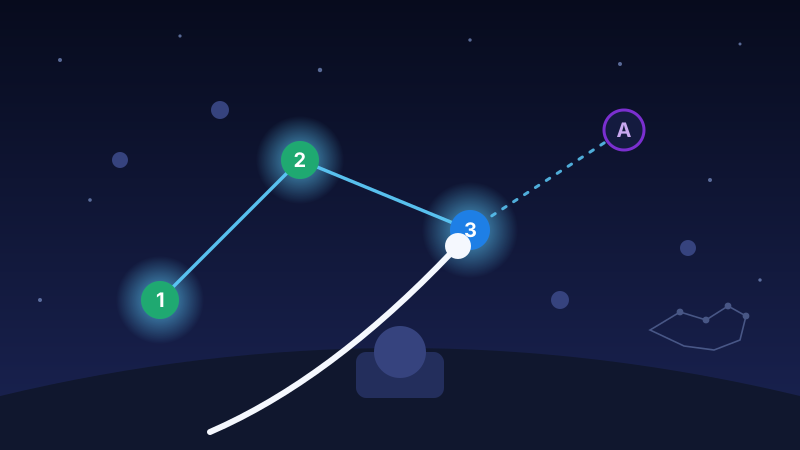
From the observatory platform, numbered stars scatter across the night dome. The patient finds and links them in order with a beam of light: 1, 2, 3… and every completed chain turns its lines into a beautiful constellation figure (lion, whale, eagle…) — a reward patients love.
Simple levels run on numbers; then letters arrive, and then the real challenge: alternating mode (1, A, 2, B…) forcing the mind to switch between two sequences — the classic, powerful workout for mental agility. For patients uncomfortable with letters, a “small to large” mode delivers the same exercise with no letters or digits at all. Unnumbered decoy stars and slow stellar drift keep the search hot.
Motor complement
When the sky widens, finding the stars is impossible without active neck and trunk rotation — safe motor scanning, with real head movement measured.
Therapeutic purpose
Trails targets processing speed and visual search, and — in alternating mode — mental switching between two sequences: the very index used by classic paper assessments.
- Slowed processing (common in MS and after stroke)
- Post-chemotherapy brain fog
- Attention disorders and older adults
Clinician guide
The design is final and the exercise is queued for production. Once released, chain length, mode (numbers/letters/alternating/size), decoy count and sky width are configured in the Level Designer.
- Follow the news section for the release announcement.
Recorded metrics
- Speed per step and per chain
- Errors (out-of-order picks)
- The alternating-to-simple speed ratio — automatic, every session
- Head-scan range on wide skies
Science & evidence
Trails trains processing speed, visual search and — in alternating mode — mental switching between two sequences; the very indices the classic paper test measures.
Scientific basis
The exercise is a 3D version of the Trail Making Test, which Reitan (1958) used to indicate brain damage and which originates in the Army test battery (Armitage, 1946). Part B (alternating numbers/letters) depends on task-switching, working memory and interference control (Sánchez-Cubillo et al., 2009); the B-to-A time ratio is a clean index of executive flexibility.
Use in the cognitive treatment pathway
Slowed processing (common in MS and after stroke), post-chemotherapy brain fog and age-related attention decline are targets. Therapy starts with short numeric chains and progresses to alternating mode; the automatic per-session B/A ratio tracks the mental-flexibility trend.
VR & digital evidence
A meta-analysis of the concurrent validity of VR executive-function assessment found significant correlations between VR and traditional measures across flexibility, attention and inhibition subcomponents (Borgnis et al., 2024).
This exercise is a rehabilitation aid, not a substitute for clinical assessment or therapy; program selection and interpretation of results remain with the care team.
References
- Reitan RM. Validity of the Trail Making Test as an indicator of organic brain damage. Perceptual and Motor Skills. 1958;8(3):271–276. doi:10.2466/pms.1958.8.3.271
- Armitage SG. An analysis of certain psychological tests used for the evaluation of brain injury. Psychological Monographs. 1946;60(1):i–48. doi:10.1037/h0093567
- Sánchez-Cubillo I, Periáñez JA, Adrover-Roig D, et al. Construct validity of the Trail Making Test: role of task-switching, working memory, inhibition/interference control, and visuomotor abilities. Journal of the International Neuropsychological Society. 2009;15(3):438–450. doi:10.1017/S1355617709090626
- Borgnis F, et al. Concurrent validity of virtual reality-based assessment of executive function: a systematic review and meta-analysis. Neuropsychology Review. 2024. doi:10.1007/s11065-024-09657-z

Request a demo
See SyneuraX up close
A live demo session for your care team — a real exercise on the headset, live monitoring on the server, and a walk through the reports. Free, with no commitment.